
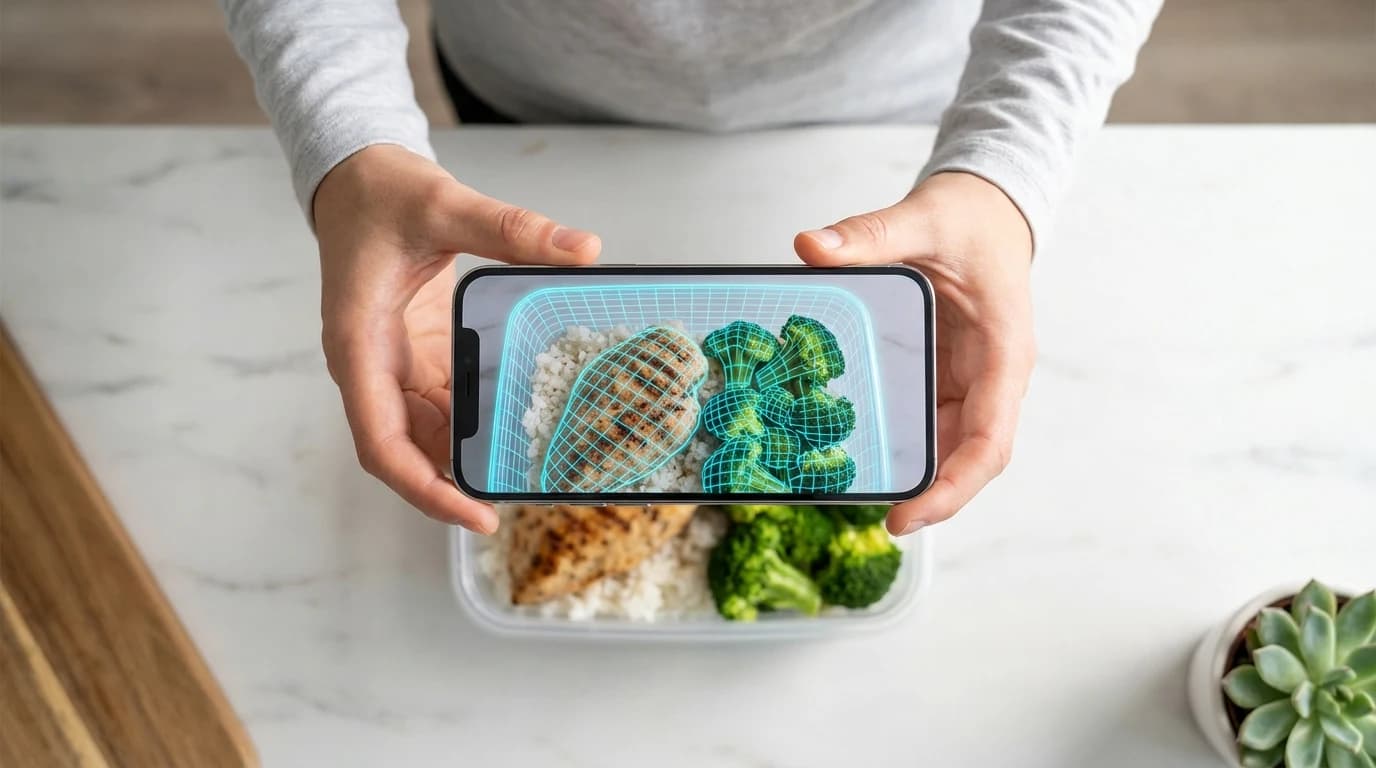
- —A digital kitchen scale measuring in grams is the most accurate tool for meal prep portioning, but visual estimation and AI apps are practical alternatives.
- —The USDA Dietary Guidelines for Americans 2025-2030 provide specific serving sizes per food group that simplify portioning decisions.
- —Weighing food raw before cooking gives you the most accurate macro calculations because cooking alters water content and total weight.
- —AI camera estimation apps can produce gram-weight estimates comparable to traditional methods when used with a reference object like a coin.
- —Consistency matters more than perfection -- tracking your food the same way each day is more important than hitting exact gram targets.
Key Takeaways
You have a fridge full of chicken, rice, and vegetables ready to be divided into five containers for the week. The question is: how much goes into each one? Accurate portioning is the difference between hitting your macro targets and guessing your way through the week. Whether you use a kitchen scale, your phone camera, or your own two hands, this guide covers every practical method for weighing food during meal prep.
Why should you weigh food for meal prep {#why-weigh-food-for-meal-prep}?
Weighing food for meal prep gives you precise control over your calorie and macronutrient intake, which is essential for anyone tracking their diet. A systematic review published in Annals of Medicine found that human error in estimating food intake is a major source of bias in dietary assessment, and that AI-based image methods can help reduce this error compared to manual guessing alone.
Portion distortion is a well-documented problem. People routinely underestimate how much they eat, particularly with calorie-dense foods like nuts, oils, and grains. A handful of almonds might look like one ounce, but without weighing, that handful could easily be two ounces -- doubling the calorie count from roughly 160 to 320 calories.
Meal prep portioning also saves you time during the week. When you weigh and divide everything on a Sunday afternoon, you eliminate daily decision-making about what and how much to eat. That consistency is best for people pursuing specific nutrition goals because it removes the guesswork from every single meal.
According to the Dietary Guidelines for Americans 2025-2030, a healthy dietary pattern includes specific amounts from each food group based on your calorie level. Knowing your target portions is the first step; accurately measuring them is the second.
What does the USDA recommend for portion sizes {#what-does-usda-recommend-for-portion-sizes}?
The USDA provides clear serving size guidelines through the MyPlate framework, which breaks daily food intake into five groups: grains, protein, vegetables, fruits, and dairy. These recommendations give you a concrete starting point for portioning your meal prep containers.
Here is a summary of USDA daily recommended amounts for a 2,000-calorie diet, based on the Dietary Guidelines for Americans 2025-2030:
| Food Group | Daily Amount | One Serving Equals |
|---|---|---|
| Grains | 6 ounce-equivalents | 1 slice bread, 1/2 cup cooked rice |
| Protein | 5.5 ounce-equivalents | 1 oz cooked meat, 1 egg, 1/4 cup beans |
| Vegetables | 2.5 cups | 1 cup raw leafy greens, 1/2 cup cooked |
| Fruits | 2 cups | 1 medium apple, 1/2 cup dried fruit |
| Dairy | 3 cups | 1 cup milk, 1.5 oz natural cheese |
These guidelines are best for general health because they are based on decades of nutritional research and represent the most widely accepted dietary framework in the United States. For macro tracking, you can convert these serving sizes into specific gram weights using the USDA FoodData Central database, which lists the exact nutritional content per 100 grams for thousands of foods.
As registered dietitian Wendy Bazilian notes in guidance aligned with MyPlate recommendations: "Portion control is one of the simplest and most effective strategies for managing calorie intake. Using standardized measurements removes the ambiguity from meal preparation."
When dividing your meal prep containers, use these USDA serving sizes as your baseline. One container for a balanced lunch might include one cup of cooked grains (roughly two ounce-equivalents), four ounces of cooked chicken breast (four ounce-equivalents), and one cup of roasted vegetables.
How do you use a kitchen scale for meal prep {#how-to-use-kitchen-scale}?
A digital kitchen scale that measures in grams is the gold standard for meal prep portioning because it provides the most precise measurements. Here is a step-by-step process for using one effectively.
Step 1: Choose the right scale. Look for a digital scale that measures in 1-gram increments, has a tare function (to zero out the container weight), and has a capacity of at least 5 kilograms. Scales in this range typically cost between $10 and $30.
Step 2: Weigh raw ingredients. Always weigh food raw before cooking for the most accurate macro calculations. According to USDA FoodData Central, nutritional databases typically list values for raw ingredients. Cooking changes water content significantly -- 8 ounces of raw chicken breast becomes approximately 6 ounces cooked, which means the per-gram macronutrient density shifts.
Step 3: Use the tare function. Place your meal prep container on the scale, press tare to reset to zero, then add each ingredient one at a time. This lets you weigh multiple items in the same container without doing mental math.
Step 4: Divide batch-cooked food evenly. If you have cooked a large batch, weigh the total amount first, then divide by the number of containers. For example, 750 grams of cooked rice divided into five containers equals 150 grams per container.
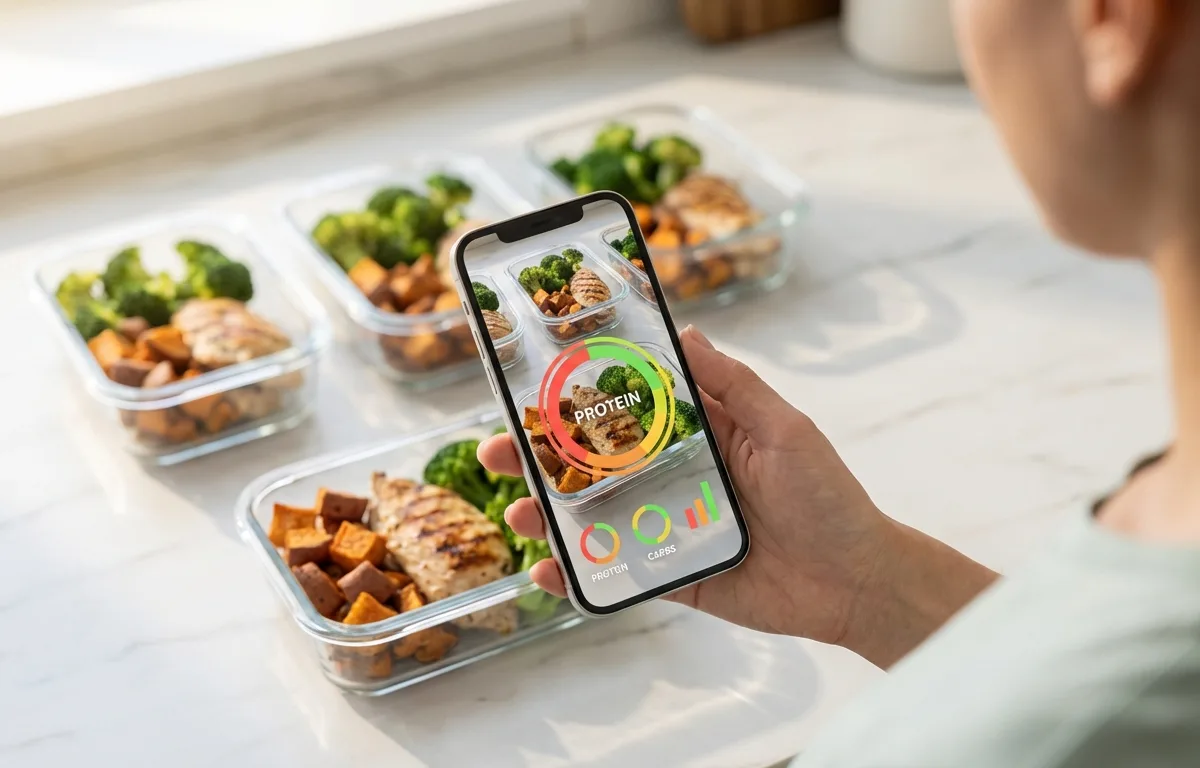
Step 5: Record your portions. Log the gram weight of each ingredient into your tracking app of choice. Using grams rather than cups or ounces reduces measurement error, particularly for dense or irregularly shaped foods. A cup of shredded chicken can vary in weight from 100 to 140 grams depending on how tightly you pack it.
This method is best suited for people following strict macro-based diets because it eliminates virtually all measurement uncertainty. The 11-23% error range that a pilot study in the Journal of Nutrition Education and Behavior found with the PortionSize smartphone app disappears entirely when you use a physical scale.
Can AI estimation tools help with food portioning {#can-ai-help-with-portioning}?
Yes, AI-powered food estimation tools are a practical alternative when you do not have a kitchen scale available, or when you want to speed up the portioning process. These apps use your phone's camera to analyze food items, estimate their volume, and calculate approximate weight using known food densities.
A pilot study by Diktas et al. (2024) published in the Journal of Nutrition Education and Behavior evaluated the PortionSize smartphone app and found that its estimated gram intake was statistically equivalent to criterion measures from Digital Photography. The app uses food-specific visual templates and a reference card placed next to the food to calibrate dimensions from the image.
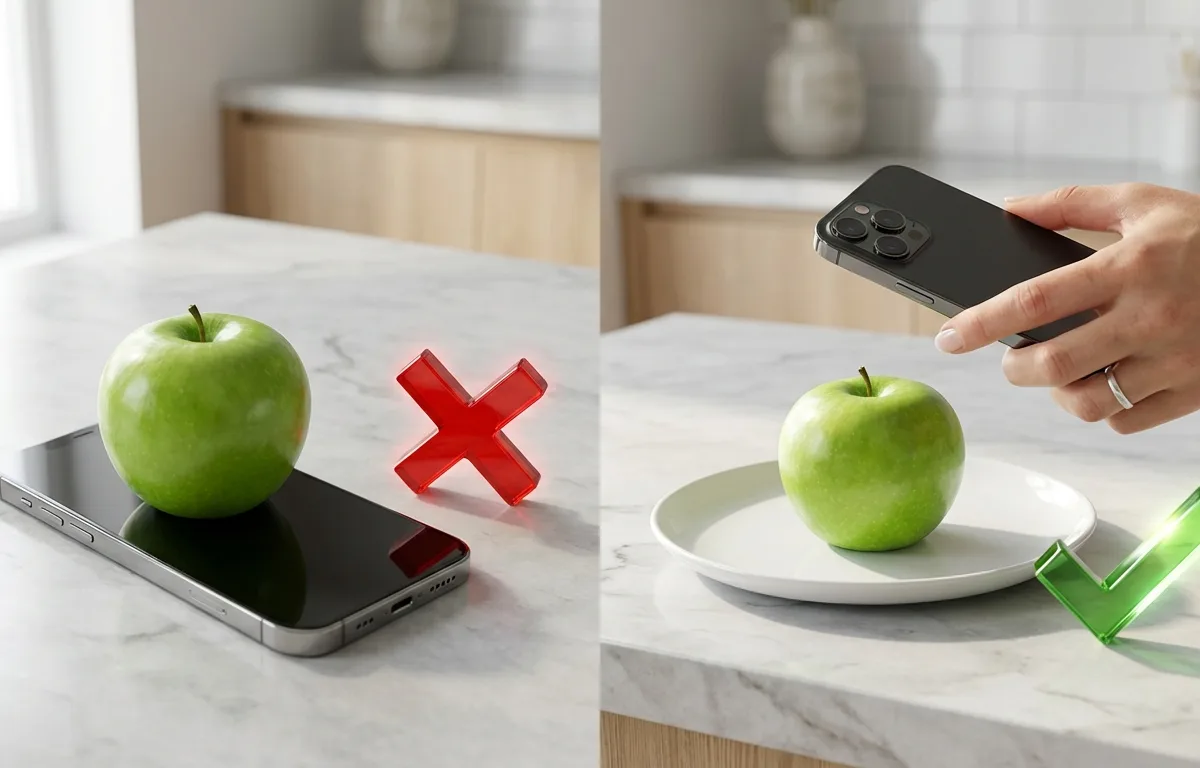
The accuracy of AI estimation depends on the food type. Solid, distinct items like a chicken breast, an apple, or a slice of bread are easiest for algorithms to measure because their shapes are predictable. Mixed dishes like casseroles, salads, or stews introduce more error because the density varies throughout the dish and ingredients may be hidden below the surface.
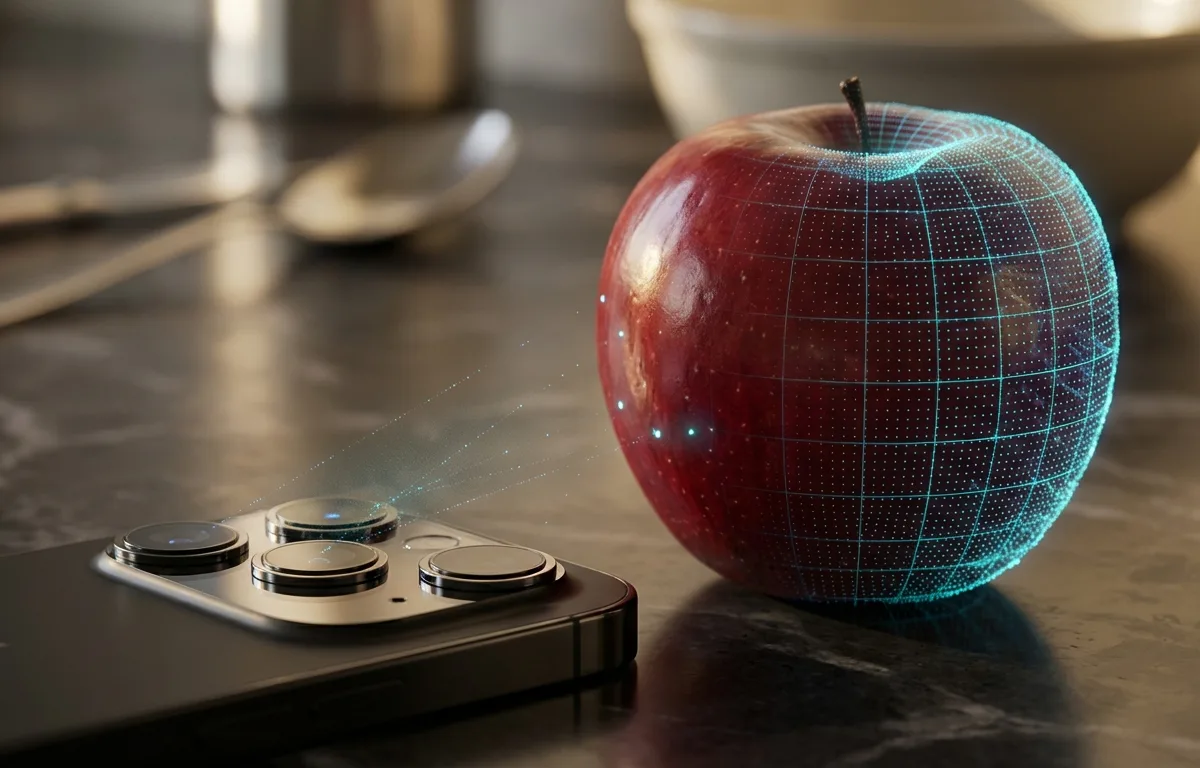
Research on image-based food portion estimation by Yang et al. (2018), published in Public Health Nutrition, demonstrated a method for smartphone-based volume estimation that does not require a fiducial marker (reference card), though accuracy improves when one is present. The study found that combining camera data with known object dimensions reduces depth estimation errors.
Modern phones with LiDAR sensors, available on recent iPhone Pro models, can map the three-dimensional surface of food with millimeter-level precision. Apple's ARKit framework provides the depth-sensing technology that nutrition apps leverage for volume calculation. Once the app knows the volume and identifies the food type, it multiplies by the average density from a nutritional database to produce a weight estimate.
AI estimation is ideal for situations where carrying a scale is impractical -- dining out, traveling, or quickly scanning pre-portioned containers. It is not a replacement for a kitchen scale when precision matters, but it closes the gap between guessing and measuring.
*Weight Scale provides AI-powered weight estimates and should not be relied upon for precision measurements. Always use certified equipment for medical or clinical dietary requirements.*
What are the best visual estimation techniques for portioning {#visual-estimation-techniques}?
Visual estimation using your hand and common household objects is a reliable fallback method when you have neither a scale nor a phone app. These techniques are endorsed by nutrition professionals and are based on standardized size references.
The hand method:
- Palm = roughly 3-4 ounces (85-115 grams) of cooked protein
- Fist = roughly 1 cup (about 200 grams) of cooked grains or vegetables
- Cupped hand = roughly 1 ounce (28 grams) of nuts or small snacks
- Thumb tip = roughly 1 teaspoon (about 5 grams) of oils or butter
The USDA MyPlate resources recommend these visual cues as part of their portion awareness education. While less precise than weighing, research consistently shows that trained visual estimators can achieve reasonable accuracy for everyday portioning.
Common object references:
- A deck of cards = 3 ounces of meat
- A tennis ball = 1 medium fruit serving
- Four stacked dice = 1.5 ounces of cheese
- A baseball = 1 cup of cereal or pasta
These visual cues work because they anchor your estimate to a standardized size. Without an anchor, most people dramatically underestimate high-calorie foods. A 2023 systematic review in Annals of Medicine confirmed that human portion estimation consistently contains significant error, which is why physical measurement or AI assistance produces better outcomes.
For a deeper look at weighing and estimation without specialized tools, check out our guide on How to Weigh Things Without a Scale: 7 Methods That Actually Work, which covers everything from the balance method to AI camera estimation.
How do you track macros accurately during meal prep {#how-to-track-macros-accurately}?
Tracking macros accurately requires combining proper food weighing with a reliable nutritional database. The process is straightforward once you establish a consistent workflow.
Choose your database. The USDA FoodData Central database is the most comprehensive free nutritional reference available, covering over 300,000 foods with detailed macro breakdowns per 100 grams. Most popular tracking apps (MyFitnessPal, Cronometer, MacroFactor) pull from this database or similar verified sources.
Weigh everything raw. Cooking methods affect water content, which changes the weight-to-calorie ratio. Raw chicken breast has approximately 31 grams of protein per 100 grams according to USDA FoodData Central. If you weigh it cooked, the protein-per-gram figure changes because the chicken lost water during cooking, concentrating the nutrients in a smaller mass. Weigh raw, log raw, and your numbers will be consistent.
Account for cooking oils and sauces. These are the hidden calorie bombs in meal prep. One tablespoon of olive oil adds roughly 120 calories. Weigh the oil before adding it to the pan, or measure it with a tablespoon. Do the same for marinades, dressings, and condiments.
Batch and divide. For batch-cooked items like a pot of chili or a sheet pan of roasted vegetables, weigh the entire batch after cooking, then divide the total macros by the number of servings you portion out. This averaging method is far more accurate than trying to estimate individual bowls from a shared pot.
| Method | Accuracy | Best For | Equipment Needed |
|---|---|---|---|
| Digital kitchen scale | Highest (within 1-2g) | Strict macro dieters | $10-30 scale |
| AI camera app | Moderate (within 11-23%) | Quick estimates, dining out | Smartphone |
| Measuring cups/spoons | Moderate | Liquids, grains, powders | Standard kitchen set |
| Hand-based visual | Lower (rough estimate) | No equipment available | None |
Consistency is best for long-term macro tracking because small daily variations tend to average out over the course of a week. If you slightly overestimate one meal and slightly underestimate another, the weekly total stays remarkably close to your target. The key is using the same method every day rather than switching between scales, cups, and guesswork.
Frequently Asked Questions
Do I need a kitchen scale for meal prep?
A kitchen scale is the most accurate tool for meal prep portioning, but it is not strictly required. You can use measuring cups, visual hand-based estimation (a palm equals roughly 3 ounces of protein), or AI camera apps that estimate weight from a photo. A scale simply gives you the highest confidence in your numbers.
How accurate are AI food weighing apps?
A pilot study published in the Journal of Nutrition Education and Behavior found that the PortionSize app produced gram-weight estimates equivalent to criterion measures in controlled settings. In free-living conditions, the app had error ranges of 11-23% for specific food groups. Solid, distinct items are estimated more accurately than mixed dishes.
What is the best way to portion protein for meal prep?
Weigh raw protein on a kitchen scale before cooking. According to USDA MyPlate guidelines, one ounce-equivalent of protein equals one ounce of meat, one egg, or a quarter cup of cooked beans. Most adults need 5 to 7 ounce-equivalents per day depending on their calorie level.
Should I weigh food raw or cooked for macros?
Weigh food raw whenever possible. Cooking changes water content and total weight -- 8 ounces of raw chicken breast typically becomes about 6 ounces cooked. Nutritional databases most commonly list values for raw ingredients, so weighing raw keeps your calculations aligned with the data.
Can I weigh food for meal prep using my phone?
Yes. AI-powered apps like Weight Scale use your phone camera and a reference object to estimate food weight and volume. While not as precise as a kitchen scale, these tools are practical for quick estimates when a scale is unavailable, especially for solid, distinct food items.
Sources
- USDA Dietary Guidelines for Americans 2025-2030 -- Federal dietary recommendations including daily food group amounts and serving size definitions.
- USDA MyPlate -- Visual portion guide and daily food plan based on the Dietary Guidelines for Americans.
- USDA FoodData Central -- Comprehensive nutritional database with macro breakdowns per 100 grams for over 300,000 foods.
- Diktas et al. (2024), Journal of Nutrition Education and Behavior -- Pilot study evaluating the PortionSize smartphone app for estimating dietary intake in free-living conditions.
- Yang et al. (2018), Public Health Nutrition -- Study on image-based food portion size estimation using a smartphone without a fiducial marker.
- Shonkoff et al. (2023), Annals of Medicine -- Systematic review comparing AI-based digital image dietary assessment methods to human assessors and ground truth.
- Apple ARKit Documentation -- Technical documentation on depth-sensing and environmental analysis capabilities used by food estimation apps.
- NIST Handbook 44 -- National standards for weighing and measuring devices.
