
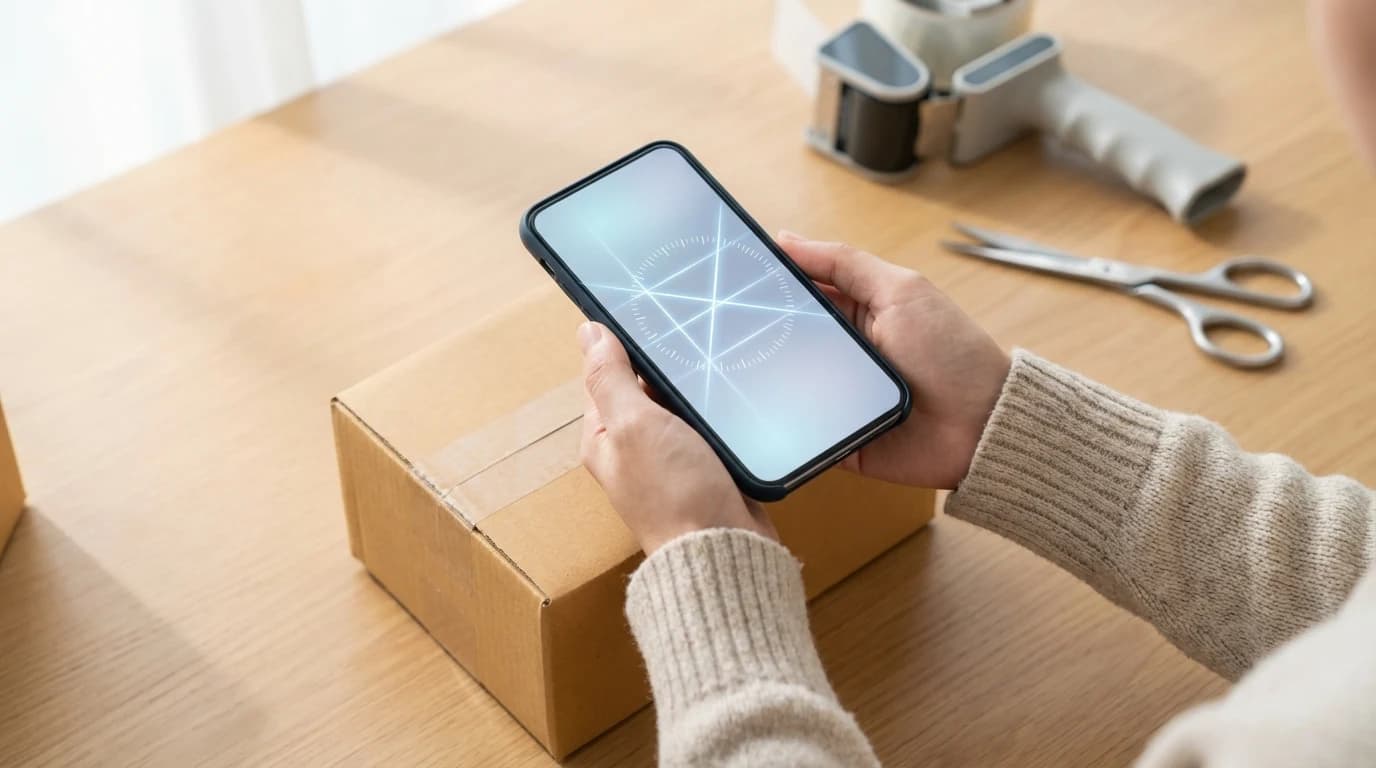
- —You can estimate package weight without a scale using AI phone apps, household reference items, or a DIY hanger balance.
- —USPS, UPS, and FedEx all use Automated Package Verification to catch weight discrepancies -- accuracy matters to avoid surcharges.
- —A standard 16.9 oz water bottle (about 1.1 lbs total) and a 500-sheet ream of printer paper (5 lbs) are two of the best household reference weights.
- —Dimensional weight (box size) often matters more than actual weight for shipping costs, especially with UPS and FedEx.
- —Always round your estimated weight up to the next full pound before purchasing postage.
Key Takeaways
You sold something online, taped the box shut, and now the shipping label asks for the exact weight. If you need to weigh a package without a scale, guessing blindly is risky -- carriers verify every parcel and will bill you for any shortfall. The good news is you have several reliable methods to estimate weight at home using items you already own. If you have already tried weighing things without a scale for food or small objects, many of those same principles apply to shipping packages.
What are the best ways to weigh a package without a scale {#best-methods}?
The most reliable ways to estimate package weight at home are using household reference items of known weight, building a DIY balance, or using an AI camera estimation app on your phone.
Each method has different strengths. The household comparison method is best for quick estimates because it requires nothing beyond items already in your pantry. According to the USPS Domestic Mail Manual, packages must be weighed to the nearest ounce for proper postage, so any estimation method needs to get you within that ballpark. The DIY hanger balance is best for accuracy because it uses the same physics as a certified balance scale, comparing your package against known counterweights. AI camera apps are best for convenience because you simply point your phone at the package and get a reading in seconds.
For most home shippers, combining two methods delivers the best result. Use the household comparison for a rough estimate, then confirm with an app or balance check.
What do USPS, UPS, and FedEx require for package weight {#usps-weight}?
All three major carriers require accurate weight declarations and use automated systems to verify them. Getting the weight wrong does not just delay your package -- it triggers automatic billing adjustments.
The United States Postal Service operates an Automated Package Verification (APV) system that uses inline scanners at sorting facilities to weigh and measure every parcel. According to USPS Automated Package Verification, if the system detects that postage is insufficient based on weight or dimensions, the mailer's account is automatically charged the difference, plus a $3.00 dimension noncompliance fee when applicable. USPS pricing thresholds are strict: packages under 15.99 ounces qualify for cheaper USPS Ground Advantage rates, so estimating carefully around the one-pound mark is critical.
UPS and FedEx apply similar verification systems. Both carriers also round up to the next full pound and compare actual weight against dimensional weight (more on that below). According to UPS shipping guidelines, you must "round any fraction of a pound to the next whole pound" for all packages over 8 ounces.
Here is a quick reference for weight thresholds by carrier:
| Carrier | Max Standard Weight | Rounding Rule | Verification System |
|---|---|---|---|
| USPS | 70 lbs | Next full ounce | Automated Package Verification |
| UPS | 150 lbs | Next full pound | In-facility dimensional scanning |
| FedEx | 150 lbs | Next full pound | Automated audit at hub |
The bottom line: always round your estimate up. Being charged for one extra pound of postage is far cheaper than the adjustment fee for underpayment.
Can you use common household items to estimate package weight {#household-items}?
Yes. Comparing your package to everyday objects with known weights is one of the oldest and most accessible estimation methods, and it works surprisingly well for shipping purposes.
The key is using items where the weight is printed directly on the label. A standard US water bottle (16.9 fl oz) weighs approximately 1.1 pounds with the cap on. According to Hammermill paper specifications, a 500-sheet ream of standard 20-lb copy paper weighs almost exactly 5 pounds. These make excellent reference benchmarks.
| Household Reference Item | Approximate Total Weight | Best For Estimating |
|---|---|---|
| Standard Bottled Water (16.9 fl oz) | 1.1 pounds | Best for small bubble mailers because it matches the weight of a typical clothing item |
| Standard Can of Soup (15 oz) | 1.1 pounds | Best for small electronics because the dense, compact weight matches boxed gadgets |
| 5 lb Bag of Granulated Sugar | 5.2 pounds (with bag) | Best for medium parcels because shoes and sweaters typically fall in this range |
| 500-Sheet Ream of Copy Paper | 5.0 pounds | Best for book shipments because the flat, dense form factor is a near-perfect match |
| Gallon of Water or Milk | 8.3 pounds | Best for large heavy boxes because it provides a reliable high-weight reference point |
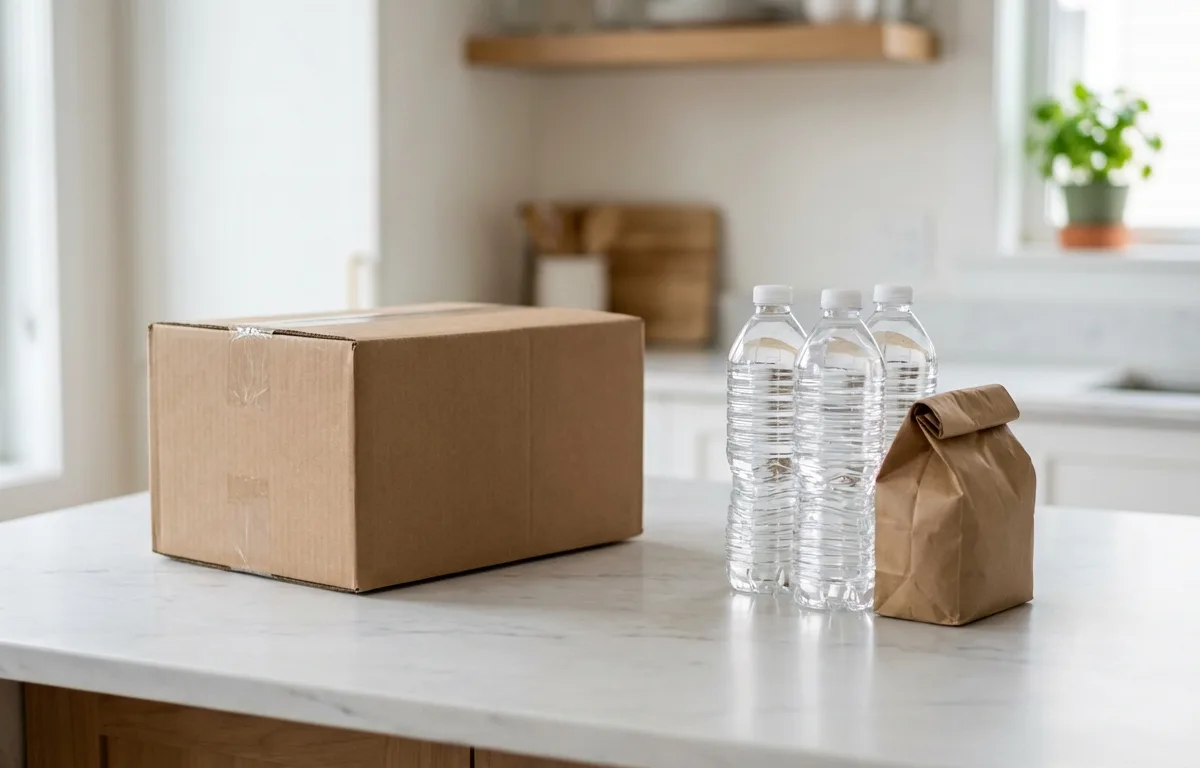
To use this method effectively, hold one reference item in your left hand and the package in your right. Stack references in a grocery bag if the package is heavier. If your parcel feels equivalent to three water bottles, estimate about 3.3 pounds, then round up to 4 pounds for postage. According to the National Institute of Standards and Technology, commercially packaged food products in the US must meet net weight accuracy standards under NIST Handbook 133, which means the printed weights on your pantry items are reliable references.
How do AI phone apps estimate package weight {#phone-apps}?
AI-powered phone apps estimate weight by analyzing a photo of the object alongside a reference item of known size, then using computer vision to calculate approximate volume and density.
The most practical approach for packages uses your phone's camera rather than its touchscreen. Apps like Weight Scale ask you to place a reference object -- such as a coin or credit card -- next to the package, then snap a photo. The AI model identifies the reference object to establish a size baseline, estimates the package's three-dimensional volume, and applies density assumptions based on your description of the contents. This method provides an estimate with a confidence percentage so you know how much to trust the result.
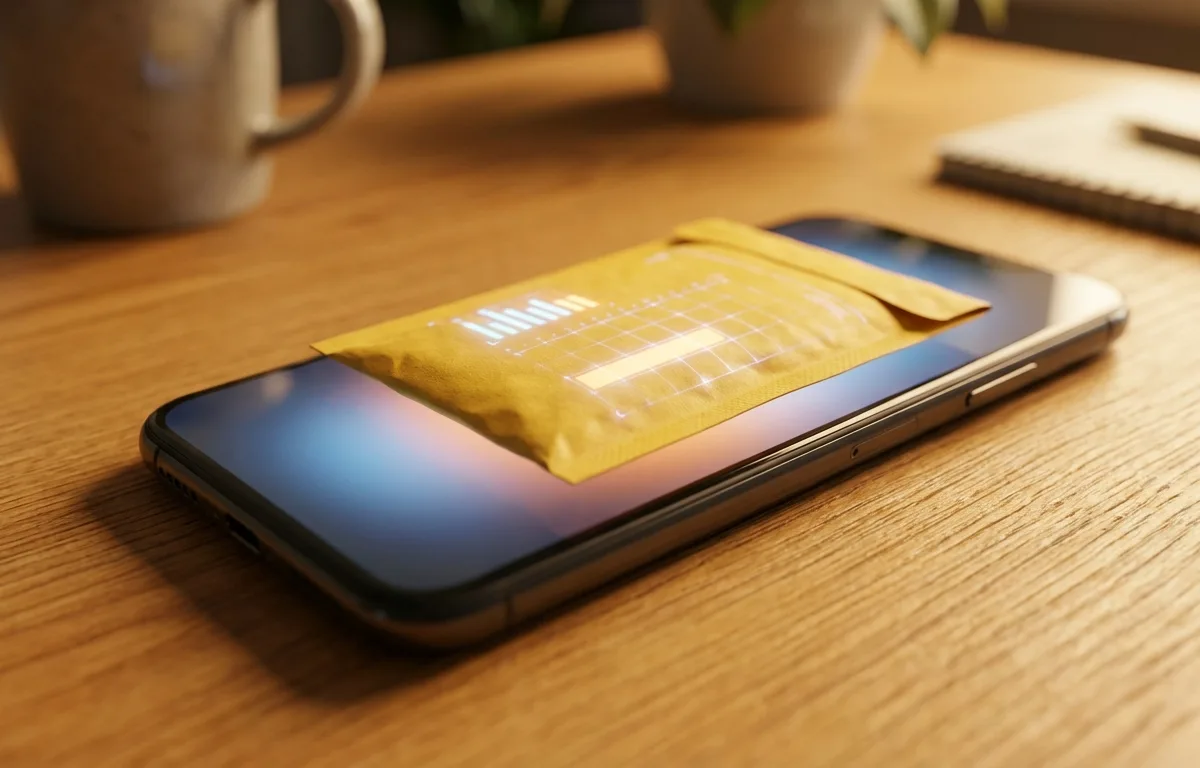
Capacitive touchscreen-based scale apps (like TouchScale for web browsers) work differently. They detect the electrical signal from a conductive object placed on the screen and estimate mass from the contact area. These are best suited for very light items -- envelopes, jewelry, and small mailers under about 15 ounces -- because of the screen's physical limitations.
*Weight Scale provides AI-powered weight estimates and should not be relied upon for precision measurements. Always use certified equipment for legal, medical, or safety-critical weighing.*
For shipping purposes, AI camera estimation is best for medium-to-large packages because it does not require placing anything on your phone screen. Cross-reference the app's estimate with a household comparison for the most reliable result.
What is the DIY balance method for weighing packages {#homemade-balance}?
The DIY balance method uses a clothes hanger, a doorknob, and reference weights to create a simple lever-balance scale that compares your package against objects of known weight.
This approach eliminates the guesswork of "hand-feel" comparison by using physics. When both sides of the hanger hang level, the weights are equal. Here is how to build one:
- Find a sturdy plastic or wooden clothes hanger with notches on each shoulder.
- Hang the center hook over a smooth doorknob or shower rod so it swings freely.
- Tie a length of string or twine around your package and loop the other end onto the left notch.
- Hook a plastic grocery bag onto the right notch.
- Add known-weight items (water bottles, canned goods, sugar bags) to the grocery bag one at a time.
- Stop when the bottom bar of the hanger rests perfectly horizontal.
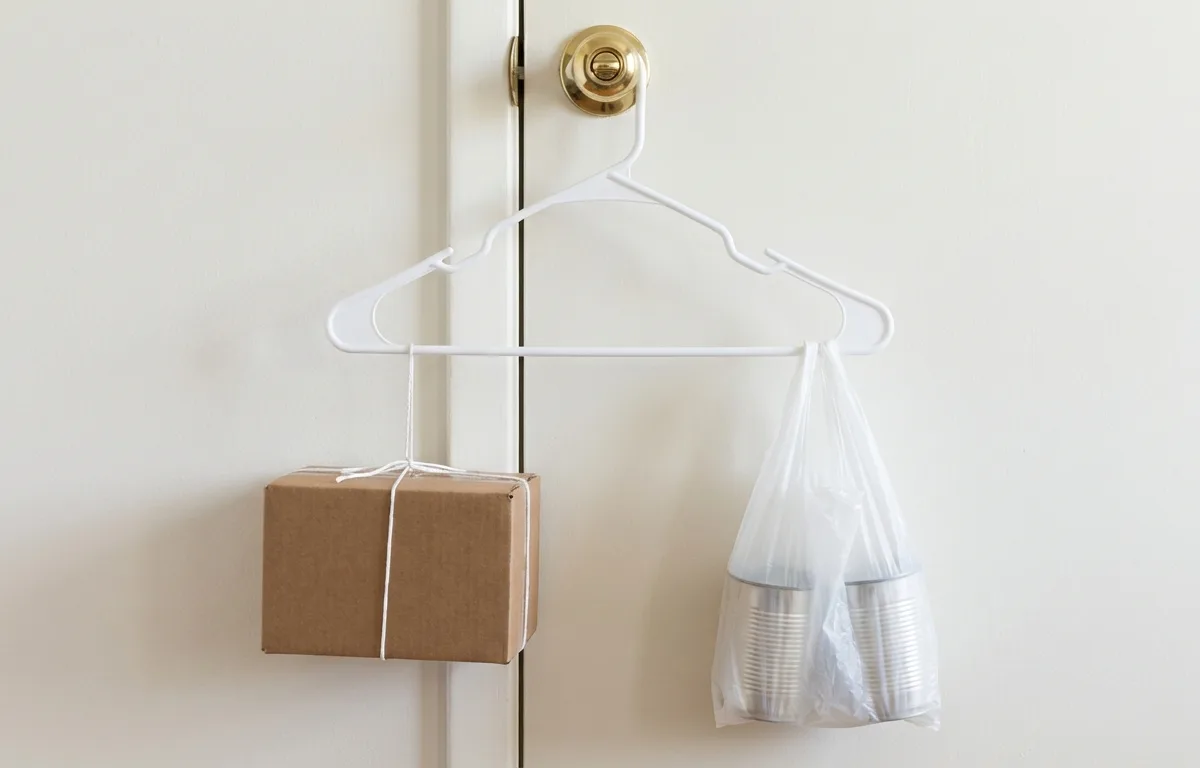
Total up the known weights in the bag -- that is your package weight. The hanger balance is best for odd-shaped parcels because you can tie string around any shape, unlike methods requiring a flat surface. For best accuracy, make sure the hanger hook is centered and the strings are the same length on both sides. According to HyperPhysics (Georgia State University), a balanced lever with equal arm lengths produces equal forces on both sides, meaning your counterweight measurement is as accurate as your reference items.
How accurate are package weight estimates without a scale {#accuracy}?
Accuracy varies significantly by method, but most home estimation techniques can get you within 1-2 pounds of the actual weight when done carefully -- which is usually close enough for shipping.
| Method | Typical Accuracy | Best Scenario |
|---|---|---|
| AI Camera App (with reference) | Within 10-20% | Best for boxes 1-20 lbs because the camera captures full dimensions |
| Household Comparison (by hand) | Within 15-25% | Best for items under 10 lbs because you can clearly feel weight differences |
| DIY Hanger Balance | Within 5-10% | Best for items under 15 lbs because it uses objective physics rather than feel |
| Bathroom Scale (subtraction) | Within 0.5-2 lbs | Best for items over 10 lbs because the scale's margin of error matters less at higher weights |
| Dimensional Weight Calculation | Exact (for billing) | Best for oversized lightweight items because carriers bill by box size |
The biggest risk is not inaccuracy itself but underestimating. According to UPS shipping guidelines, if the billable weight (the greater of actual weight and dimensional weight) exceeds what you declared, you will be charged the difference. Overestimating by a pound costs you only the price difference of one weight tier. Underestimating triggers an adjustment fee on top of the postage difference.
For this reason, always round up after estimating. If your hanger balance shows about 3.5 pounds, declare 4 pounds. The small upfront cost protects you from fees that are often $1-3 per package. For a deeper look at accuracy across different estimation techniques, our guide on how to weigh things without a scale covers the balance method, water displacement, and more in detail.
Can you estimate shipping cost from box size alone {#dimensional-weight}?
Yes. Carriers use a formula called Dimensional Weight (DIM weight) to charge you based on box size rather than actual weight when the box is large relative to its contents. In many cases, DIM weight determines your shipping cost even if the package is light.
According to the UPS Package Dimensions guide, the formula is straightforward: Dimensional Weight = (Length x Width x Height in inches) / DIM Divisor. The divisor varies by carrier and rate type:
- UPS Daily Rates: Divisor of 139
- UPS Retail Rates: Divisor of 166
- FedEx: Divisor of 139
- USPS: Divisor of 166 (for Ground Advantage and Priority Mail)
For example, if your box measures 12" x 12" x 12", the volume is 1,728 cubic inches. Dividing by 139 (UPS Daily) gives a DIM weight of 12.4 pounds, rounded up to 13 pounds. Even if your actual package only weighs 3 pounds, UPS would bill you for 13 pounds.
According to Pitney Bowes Parcel Shipping Index, dimensional weight pricing is a growing factor in e-commerce shipping costs, as more carriers apply DIM rules to ground shipments. The practical takeaway: always use the smallest box that safely fits your item. An oversized box filled with packing peanuts can easily triple your shipping cost due to DIM weight penalties.
Frequently Asked Questions
Does the post office round up package weights?
Yes. USPS, UPS, and FedEx all round up to the next full ounce or pound. A package weighing 1.1 pounds will be charged at the 2-pound rate. Always round your estimate up before purchasing postage.
What happens if I underestimate my package weight?
USPS Automated Package Verification catches weight discrepancies at sorting facilities. You will be automatically billed the postage difference through your shipping account, often with a small adjustment fee added.
Can I use a bathroom scale for small packages?
Bathroom scales are rarely accurate for items under 5-10 pounds because they are calibrated for human body weight. If you must use one, weigh yourself holding the package, then weigh yourself alone, and subtract the difference.
Are digital phone scale apps safe for my screen?
Capacitive-based scale apps are generally safe for lightweight items. AI camera apps like Weight Scale avoid screen contact entirely by using your phone camera to estimate weight from a photograph with a reference object.
How do I calculate dimensional weight for UPS?
Multiply the package length, width, and height in inches. Divide by 139 (UPS Daily Rate divisor) or 166 (UPS Retail Rate divisor). UPS charges whichever is greater: actual weight or dimensional weight.
Sources
- USPS Domestic Mail Manual -- Official USPS mail classification and weight standards for all domestic shipments.
- USPS Automated Package Verification -- Official USPS guide to APV, correct postage calculation, weight rounding rules, and the $3.00 dimension noncompliance fee.
- UPS Package Dimensions Guide -- Official UPS guidelines for measuring packages and calculating dimensional weight with divisor values.
- FedEx Packaging and Shipping -- FedEx shipping packaging guidelines, size limits, and dimensional weight rules.
- National Institute of Standards and Technology (NIST) -- US agency responsible for weights and measures standards including NIST Handbook 133 on commercial packaging.
- HyperPhysics - Torque and Balance -- Georgia State University physics reference on lever-balance principles.
- Pitney Bowes Parcel Shipping Index -- Annual industry report on US parcel shipping volumes, costs, and carrier trends.
- Weight Scale -- AI-powered weight estimation app using phone camera and reference object calibration.

